Clearing Ground for the Systems That Keep Your Home Running
Excavation in Blakeslee & Brodheadsville, PA, for water line breaks, sewer replacements, and failed underground pump systems
Magnus Mechanical provides excavation services in Blakeslee and Brodheadsville, PA, for homeowners who need access to buried water lines, sewer pipes, pump systems, and underground utilities. Whether a water line has ruptured under your driveway or a sewer connection has failed below the yard, excavation opens the ground in a controlled way so repairs can be completed without guessing at pipe location or depth. This service is not about moving dirt for the sake of digging but about creating safe, accurate access to infrastructure that cannot be reached any other way.
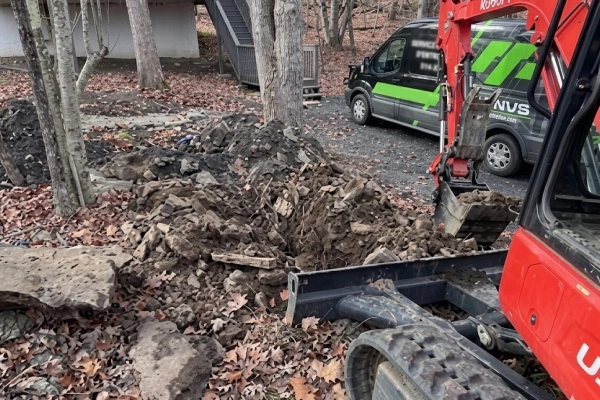
The process begins with site planning that accounts for existing structures, landscaping, utility lines, and drainage patterns. Equipment is positioned to minimize damage to surrounding areas while still allowing room to work. Excavation depth and trench width are determined by what needs replacement or repair, whether that means reaching a waterline four feet down or uncovering a sewer lateral that runs beneath a stone patio. The goal is to expose the problem clearly, give technicians room to work, and leave the site in a condition that allows for clean backfill and restoration once the repair is finished. In areas where frost penetration and seasonal ground movement are common, depth matters not just for access but for long-term system performance.
If your property has underground utility damage or you need excavation to support a system replacement, reach out to discuss site conditions and project scope.
Excavation That Supports the Repair, Not Just the Hole
You do not hire excavation by itself. You hire it because something underground has stopped working and needs to be replaced or reconnected. Magnus Mechanical approaches each excavation with that in mind, coordinating digging with the plumbing, pump, or utility work that follows. Trenches are dug to the width and depth required for safe pipe installation, and spoil piles are managed so they do not block access or create drainage problems while work is underway. Excavators used on residential properties are sized to fit between homes, along driveways, and through yard access points without tearing up more ground than necessary.
After the repair or installation is complete, you will notice clean backfill, compacted soil where trenches were opened, and a yard that has been returned to a manageable state. While grass and landscaping take time to recover, the work itself leaves no exposed pipes, unstable ground, or debris piles behind. Magnus Mechanical restores grade and drainage flow as part of project completion, so water does not pool where a trench was dug and surface runoff continues to move the way it did before excavation began.
Timelines vary depending on soil type, trench length, and weather conditions, but communication remains consistent throughout the project. If ledge or unexpected utility conflicts are encountered, adjustments are explained before proceeding. This service does not include hardscape reconstruction such as rebuilding patios or resetting retaining walls, though coordination with other trades can be discussed during planning.
What to Expect When Excavation Becomes Necessary
Excavation is rarely planned months in advance, and questions about process, timing, and site impact are common once the need arises.
What determines how deep the trench needs to go?
Trench depth is based on the location of the pipe or system being accessed, local frost line requirements, and whether the line must slope for drainage. Water lines are typically buried below frost depth to prevent freezing.
How is surrounding property protected during excavation?
Equipment is positioned to avoid structures, septic fields, and utility lines, and access routes are planned to limit turf damage. Locate services are contacted before any digging begins.
When does excavation happen in relation to the actual repair?
Excavation occurs immediately before the repair or installation work begins, so the trench remains open only as long as necessary to complete the underground work and backfill properly.
Why does excavation sometimes take longer than expected?
Ledge, saturated soil, or unexpected utility crossings can slow progress. Weather conditions in Blakeslee, especially during freeze-thaw cycles or heavy rain, also affect how quickly ground can be opened and closed.
What happens to the excavated soil?
Soil is set aside during the dig and used for backfill once the repair is finished. Excess material is graded evenly or removed if it cannot be redistributed on site without affecting drainage.
If you are facing a water line failure, sewer issue, or pump system replacement that requires excavation, contact Magnus Mechanical to walk through site conditions and coordinate the underground work with the repair that follows.